Instrument In Focus: Jouhikko
The story of the jouhikko, like the story of many traditional instruments, is the story of an old instrument rediscovered and given new life. In fact, it is very old: one of the earliest possible representations of this type of instrument is the stone carving in Trondheim Cathedral, Norway, dating from the second quarter of the 14th century.
The jouhikko is a member of the bowed lyre family; a lyre played with a bow — it's a type of instrument that can be found over a wide area, from Russia in the east, through Scandinavia, to Britain and Ireland. There are many relatives of the jouhikko in this family: the four-stringed Estonian talharpa and hiiu kannel have a wider fingerhole and can play a wider range and shifting drones. The Welsh crwth is the largest, with six strings, a fingerboard, and a complex playing style. Other variations include the Shetland gue and the English crowd.
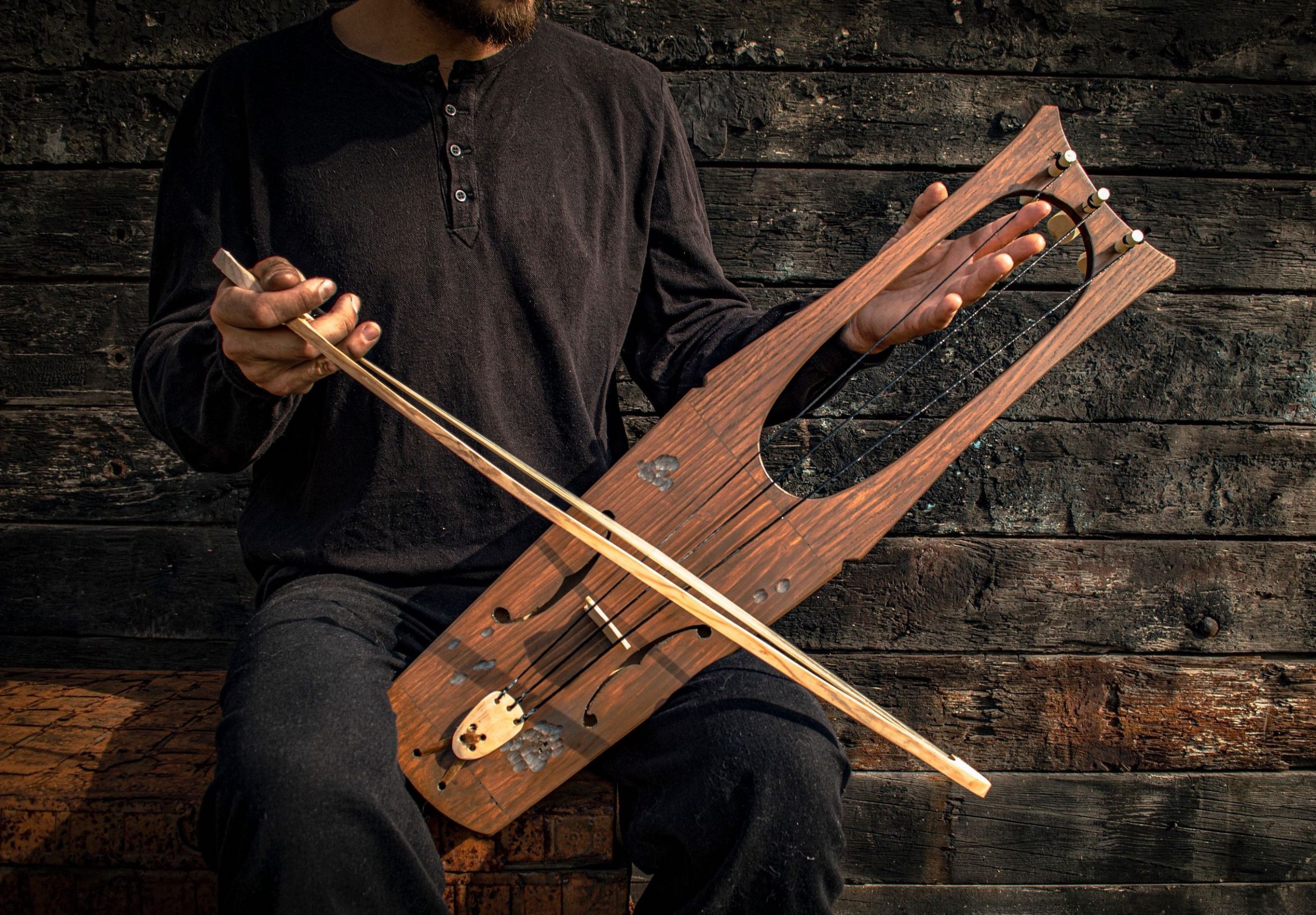
Traditionally, the strings of the Finnish lyre are made of horsehair, which is reflected in the instrument's name ("jouhikko" roughly means "horse-haired lyre"). The body is made of wood and varies in size and shape from region to region. The scale of the jouhikko is only 6 notes, with a constant drone.
At the end of the 19th century, the tradition of jouhikko survived only in the villages, but in Finland, as in other countries, there was an entographic boom: in search of their national roots, Finnish intellectuals became interested in traditional music, dance, epic poetry, all of traditional culture. So folk music collectors began visiting performers in Finland and Karelia, collecting instruments, writing down melodies, making field recordings, and taking photographs.
The most important collector for the fate of jouhikko was probably Armas Otto Väisänen, an eminent Finnish folk music scholar. He traveled not only in Finland but also in Russia to collect Finno-Ugric folk melodies. He made excursions to such regions as Mordovia, Ingria, Veps, Russian Karelia. From 1913 to 1931 he collected a small repertoire of jouhikko pieces: but jouhikko was used for playing dance music, and the collected pieces are very short and mostly improvised.
And then jouhikko didn't disappear and didn't stay only in the villages: in the 1970s and 1980s the tradition of playing jouhikko got a new life. The Sibelius Academy in Helsinki and the Finnish Folk Music Institute in Kaustinen started courses in playing and, more importantly, making jouhikko.
The truth about the jouhikko is that it's not the most comfortable instrument to play. In fact, modern musician Ilkka Heinonen, master of the jouhikko, jokes that he hates the "user interface" of the instrument. The jouhikko is played with a horsehair bow with an underhand grip, and because it has no frets, players must develop a keen ear for pitch and intonation. Also, since there is no fretboard, you have to stop the strings with the backs of your fingers (or your knuckles, or your fingernails), and then to touch the melody strings you have to stick your hand through a hole in the top of the instrument. Pretty awkward! But unique.
But that's the thing — like many traditional instruments, the uniqueness is what makes it so amazing. The jouhikko, with its haunting, droning sound, is unlike any other instrument. And if you learn to work with it, you can make something that is far from anything else.
In the words of Ilkka Heinonen: "There is no one and only way to play the jouhikko, just sounds that suit different functions. But it makes no sense to imitate other instruments with the jouhikko. I always strive to find a connection with the Karelian tradition because there, the jouhikko is in its element and feels meaningful".
The jouhikko is more than just an instrument; it serves as a symbol of Finnish and Karelian cultural identity, embodying connections to folklore, nature, and community storytelling through music.
At this year's FFT, the jouhikko will be brought to life by Pekko Käppi, another prominent Finnish jouhikko player.