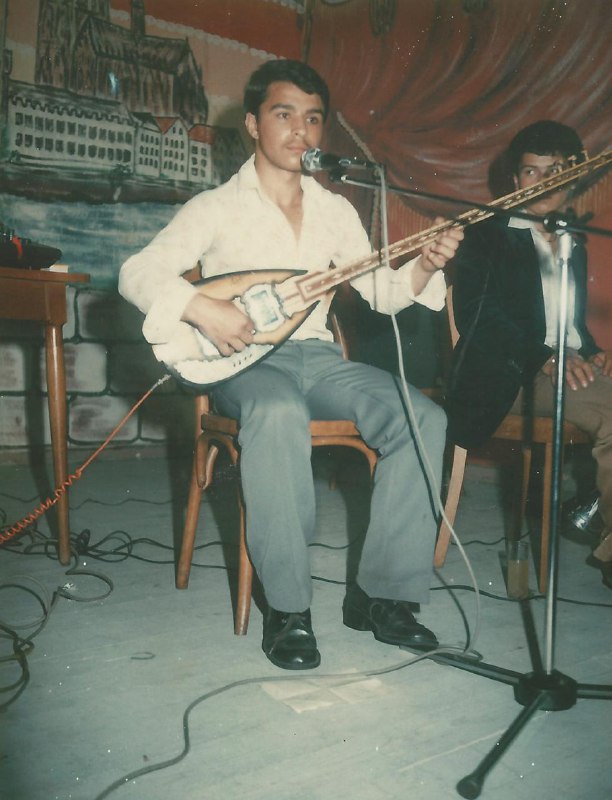
Gasterbeiter Music of Berlin
This year's Freeform Tradition festival is taking place in Berlin, a city that aligns well with the theme of the 2025 edition, Lines / Borders. It is a city where many cultures, traditions, and groups converge and intermingle.
Since the early 20th century, Berlin has played a significant role in documenting and studying Turkish music. Under the direction of figures like Kurt Reinhard, a professor at the Free University of Berlin, the Berlin Phonogramm-Archiv amassed one of the world’s most important collections of Turkish music recordings. From the 1950s onward, Reinhard and his wife, Ursula, conducted extensive fieldwork in Turkey, preserving a wide variety of traditional music, including folk and art music as well as music from minority communities. These collections are now housed in the Ethnologisches Museum Berlin and form a unique archive of Turkish musical heritage outside of Turkey.
An important tradition in Berlin music is "Gastarbeiter" music. Its history in Berlin is inextricably linked to the history of Turkish migration to Germany. In the 1960s and '70s, large numbers of Turkish Gastarbeiter (guest workers) arrived in Berlin, bringing their musical traditions with them. Isolated in their own communities, the Gastarbeiter created a vibrant parallel world of music venues (gazinos), record shops, and local labels. These spaces became cultural hubs that hosted performances by prominent Turkish artists and fostered a unique subculture that was largely invisible to mainstream German society.
Gazinos, live music venues where Turkish migrants gathered to enjoy performances, food, and a sense of community, were central to Gastarbeiter music. Spaces like the renowned Turkish Bazaar at Berlin’s Bülowstraße U-Bahn station became cultural hubs, hosting local and visiting Turkish stars. They also featured music shops and record labels, creating a self-sustaining ecosystem for Turkish music in Germany.
The music was diverse, encompassing Turkish folk, arabesque, and pop. It was often performed with traditional instruments, such as the bağlama (saz), a long-necked lute central to Anatolian music. The lyrics frequently reflected the migrant experience, expressing themes of longing and homesickness and the challenges of life in a foreign land.
Gastarbeiter music developed its own stars, distribution networks, and record labels, operating almost entirely outside the German mainstream. For many, it was a lifeline to their homeland and a way to express cultural pride and the challenges of migration. The scene was so insular that notable artists and songs were sometimes forgotten within the community, only to be rediscovered decades later.
The children of guest workers blended these traditions with Western genres, notably pioneering Turkish-German hip-hop in the '80s and '90s. Nevertheless, the original Gastarbeiter music is a testament to the resilience and creativity of the Turkish diaspora. It captures the emotional and social realities of migration through song.
“It was really, in a funny way, a parallel world,” says Imran Ayata, co-compiler of the influential Songs of Gastarbeiter compilations. He describes how thousands would attend concerts by Turkish stars in Berlin, unnoticed by most West Berliners at the time.
Once overlooked, Gastarbeiter music is now recognized as a vital part of Germany’s cultural history and is celebrated in documentaries, compilations, and festivals that highlight its enduring influence.