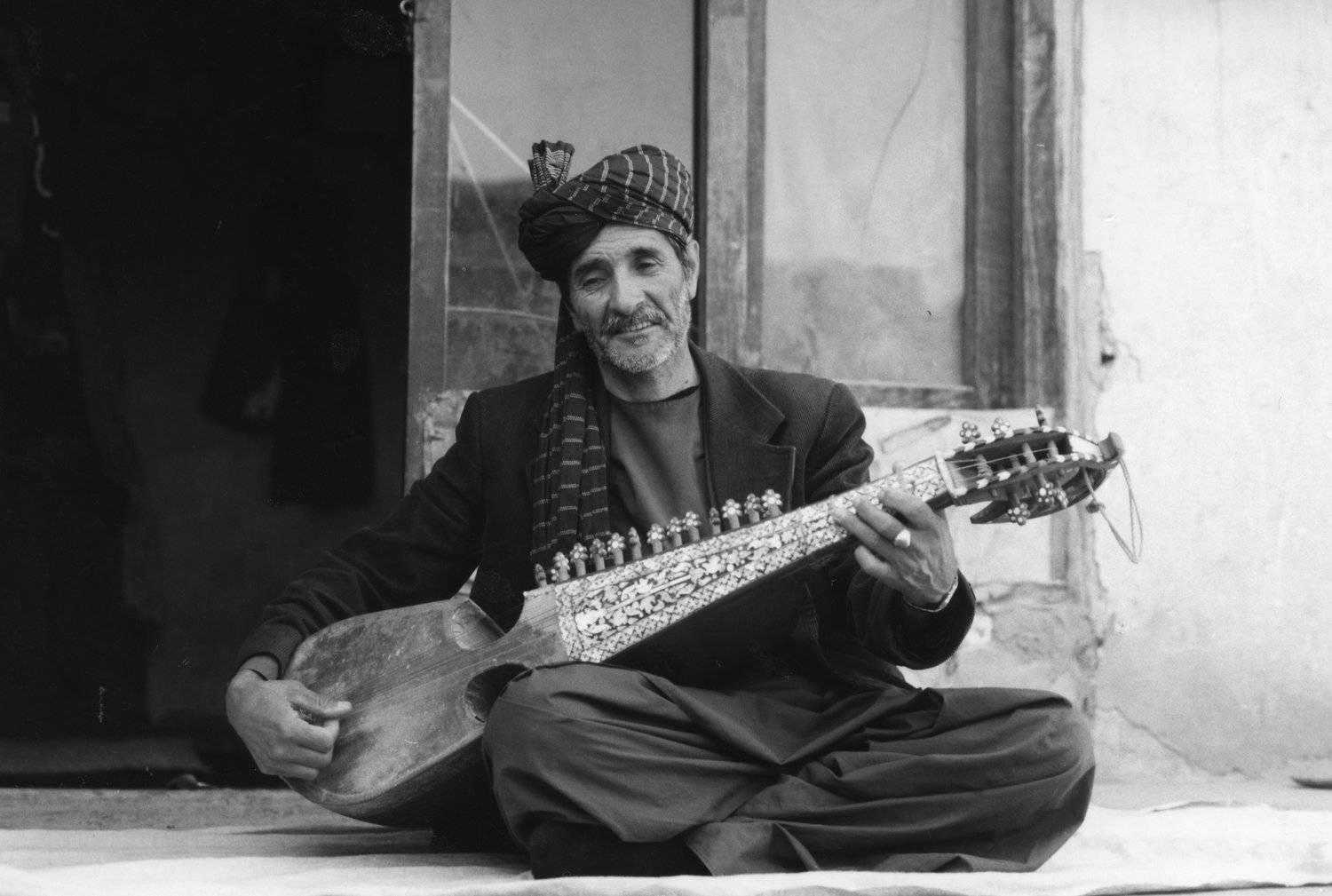
Instrument In Focus: Rubab
The rubab is one of the world’s oldest and most storied musical instruments. It is deeply traditional yet always evolving. From its origins in Central Asia, it has journeyed across continents via trade routes, migrations, and music itself. The earliest known mention of the rubab (also spelled rabab, rebab, or rabob) appears in tenth-century Arabic texts. Scholars like Al-Farabi compared it to the tanbur of Khorasan, a long-necked lute.
With its carved wooden body and animal-skin membrane, the rubab belongs to an ancient family of double-chambered lutes, including the Iranian tar and the Indian rabab. The rubab held a prominent place in the musical traditions of the Persian and Islamic worlds, and it is frequently referenced in Persian literature and Sufi poetry.
The rubab’s influence spread far beyond its heartland in present-day Afghanistan and historical Khorasan. Through Islamic trade routes and cultural exchanges, it traveled east and west. In Central Asia, it became integral to the musical traditions of Afghanistan, Pakistan, Iran, Tajikistan, and Uzbekistan. Its presence also extended to regions such as Xinjiang in China and Kashmir and Punjab in India.
The rubab made its way to Europe through two distinct paths. One path was through the evolution of a pear-shaped version into the Byzantine lira in the 9th century, a precursor of the violin. Meanwhile, a boat-shaped version was brought to Spain by the Arabs in the 11th century. This influenced the development of the rebec and eventually the European violin family.
The rubab arrived in India around the 14th or 15th century and gained prominence in the 16th century. It played a foundational role in Sikh devotional music, particularly through Bhai Mardana, Guru Nanak's companion, who used the instrument to accompany sacred hymns. This gave rise to the rababi tradition within Sikhism.
Often called "the king of instruments," the rubab is one of Afghanistan’s two national instruments. It is also considered the ancestor of the Indian sarod, which evolved from the rubab during the Mughal period, particularly in cities like Lucknow and Calcutta in the 19th century.
Traditionally, the rubab is carved from a single piece of mulberry wood to form a hollow, boat-shaped body that serves as a resonating chamber. The front is covered with a membrane made of goat or sheep skin, which gives the instrument its rich, earthy tone. The instrument typically has three melody strings made from gut or nylon, as well as two or more drone strings and 10 to 15 sympathetic strings that vibrate with the melody, creating a complex, harmonic soundscape.
In December 2024, UNESCO inscribed the art of crafting and playing the rubab on its Representative List of the Intangible Cultural Heritage of Humanity. This recognition honors the instrument’s deep cultural roots in Afghanistan, Iran, Tajikistan, and Uzbekistan and acknowledges its historical importance across Central, South, and Southwest Asia.
The UNESCO listing celebrates the rubab’s enduring role in rituals, festivals, spiritual gatherings, and contemporary music. It also highlights how the rubab fosters cultural unity, encourages intercommunity dialogue, and preserves a vital tradition of musical craftsmanship for future generations.
Here's what 13th-century Sufi mystic Rumi wrote about the rubab:
"Do you know what the voice of the rabab is saying?
Come follow in my steps and find the way;
Since through error you’ll discover what’s right,
Since through questions you’ll end up with answers."