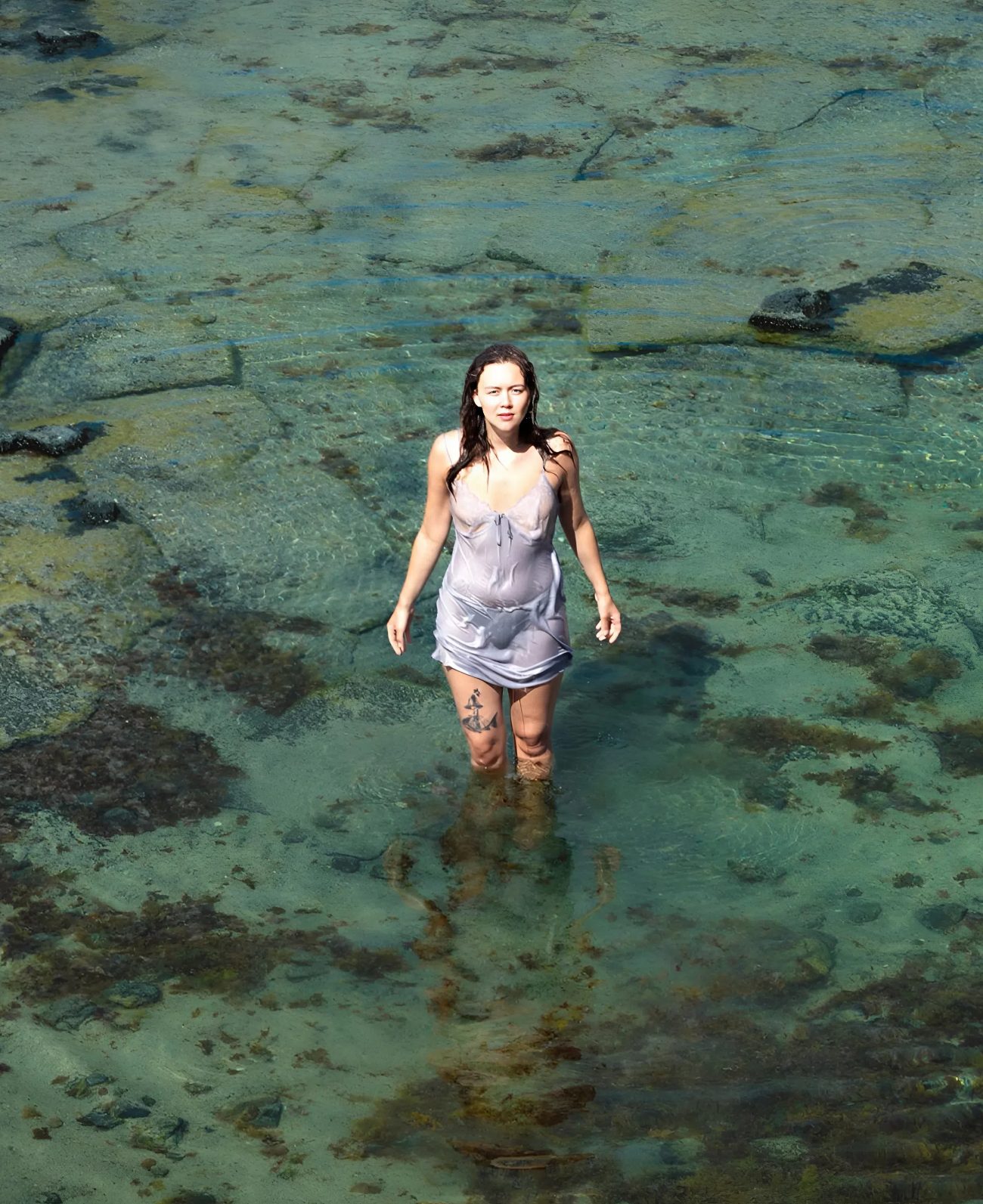
Iris Marie: “In Berlin, it's possible to create and belong to something”
Iris Marie is a folk musician born in Norway and based in Berlin, who performs under the name Iris Mar. She grew up 100 metres from the sea, near the Trondheim Fjord in Frosta. She came from a musical household where her parents performed and taught her traditional Scandinavian tunes.
Later in life, she moved to Oslo and Copenhagen, where she broadened her musical knowledge. Eight years ago, she moved to Berlin and settled in a city famous for its thriving and lively music scene.
This year, she released her debut album, Salt, on Anette Records. On 6 December, she will present it with a live show at Schloss Frizzante.
We talked to Iris about her musical upbringing, her move to Berlin, the English language, and sourdough baking.
Let's start with your musical upbringing. Did you learn music from a very early age, as a child?
I grew up in a musical home with parents who are both musicians, and I grew up in a folk-music environment. My parents played all kinds of instruments, and very early on I started playing around with all the instruments that were in the house. Somebody asked me the other week when I started to do music, and I don’t really know the answer. I just know — it’s a cliché, but it’s true — that I was singing before I could speak. And then I started to play the fiddle when I was six. And then it just went on from there.
Norway is famous for its musical culture and musical education. Did you go on to learn music somewhere outside of your family and home, in school, or at a university?
Yes, I started taking fiddle lessons when I was six. My father was the teacher, but it was in this cultural school. And then I had some vocal lessons later. But I was a bit stubborn. It wasn't pushed on me that I had to do music. I taught myself piano and guitar, and started to write songs when I was 13. And then I went to Denmark to study songwriting and vocal technique in Copenhagen.
What was the place you grew up in like? It says on your website that it was “100 metres from the sea”, and sea imagery is very prominent on your album.
I grew up in this house, just up a little hill, 100 metres from the Trondheim Fjord, in the middle of Norway, at Frosta. And it's a peninsula that goes southwards into the sea. My entire childhood, I would run around on a rocky beach, and build cabins and spend time with the sea. And it's also the first thing you see when you wake up in the morning. You look out the window, and you look at the ever changing fjord and the light and the mountains on the other side. Coming from a place like that is incredibly important to who I am.
What kind of music did your parents listen to and play? Was it traditional Norwegian music, or something else?
It was traditional Scandinavian folk music, with the fiddle band and everything. And this is a subculture in Norway. It's actually becoming a bit more popular now, because it's combining into club music, the old folk tunes. But yeah, fiddles and flutes, and tunes that you’re supposed to learn from this old guy up on the hill, they are passed on by ear, and you meet with him and drink coffee and learn tunes. And also these folk musicians travel around and exchange tunes with each other. But at the same time, my mom was very into medieval ballads, and kind of more the vocal tradition, which is also spanning to English traditional music. And my dad, an amazing guitarist, was also very well schooled in the blues and the tradition of West African, Mali music, and Hawaiian traditional music.
How did you end up in Berlin?
I was living in Oslo and studying, and I wasn't pursuing music [professionally] then. But the music always remained a part of who I am. After I finished my studies in Oslo, I was free, and I always wanted to go out into the world. And so, I bought a one way ticket to Berlin, and I had a place to stay for a month. I wanted to check out the city. There, I ended up in some open mics and met some really friendly, beautiful people in the folk and singer-songwriter scene here. I ended up staying for much longer than a month — it's been over eight years now.
Did you end up staying because of the music scene and the musical opportunities, or was it something else about Berlin that made you stay?
I think it was because of the people. I was immediately welcomed into the musical space, and that led me to think that it’s possible to create here, and belong to something, in a very different way than I'd experienced before. Berlin is also this collection of people that left their home countries and cities, and find some solace in each other's company. We're all a bit outsiders, and it's a good place to create.
You described your home as a place surrounded by nature. Berlin is very much an urban setting. Do you miss nature? Does the city still inspire you?
I miss nature and being in it a lot. The feeling of the city is not really giving me so much anymore. It was really important for my foundational years, to meet all these people, to grow and learn, and be inspired. And now, I am thinking about the sea a lot. In Berlin, it’s still about the people, the culture, what you can create together with others — it’s worth a lot. The people still inspire me. I’m not so sure about the city.
When you moved to Berlin, you had to work as a baker to support your musical career. Is it something that’s still a part of your life?
I actually still do a little bit. I'm a sourdough baker, which started back in Norway. I had a seasonal job in a bakery. And then, when I moved here, I needed a job to support the music. I started working with this amazing person, and we developed a café bakery into a bread bakery. I spent five years doing that, it's a huge passion of mine. I thought it would be just a day job to support my creative endeavours, but it ended up taking a lot of space in my heart as well, because it’s super creative. You can shape things and develop things, and that gave me a lot. I also think it’s very healthy to not just be a kind of floating musician, with your head in the clouds all the time, but to be at a workplace and do something with my hands, something concrete and social.
Berlin’s folk and singer-songwriter scene is important for you, but it’s very much a multicultural city with a lot of different scenes, venues, and kinds of music. Are you influenced by other genres and scenes here?
Yes, absolutely. I think I have a pretty eclectic taste in music. I don't like to stay in my lane. Of course my expression, what I put out, is going to be true to me, but I still listen to other things. But I do love the experimental ambient scene in Berlin, for example. That's super cool. And I also went to folk jams with Mediterranean people, where it's like 12 people playing nonstop for seven hours. Greek songs, the Turkish ones, the Cypriot ones, and it goes and goes. Or hip hop, I like the weird underground sound. There's a really cool funk, R&B jam, the Cassette Head Sessions, I went there a couple of times and had a blast. That's the beauty of this city. You can float around and find something nice in every corner.
How did your album come about?
It started in '22, when I was going through some changes in my life. I'd been a live musician for a long time, and written all these songs, but never really dared to record them. I was only doing home recordings. But then I got this megalomaniac idea that I should make an album. It’s called “Salt”, and I think it started with me thinking about the concept of salt. It was the summer in Berlin. I started thinking about essences, and the importance of salt, and how it is in everything and everywhere. It’s this connector. This also came from baking: when you work with dough, salt binds it, but it also slows down fermentation. It burns if you put it in a wound, but it also cleanses it and heals. I was thinking about salt and wrote five songs in one go. It felt like it was time for a big project — I had a clear concept, and I was ready for it.
How easily were you able to find collaborators then, people to work with? The studio and the label. Was it difficult, or did you already have some connections?
It was difficult, even with connections. It was a long road. I started recording demos that autumn, after I became obsessed with salt. And then, I reached out to my old songwriting teacher from Copenhagen, Kaspar Kaae. He is a film composer and a rock musician. I met up with him, and he wanted to record me. I went to his studio in Copenhagen in the winter and did the first round of recordings, which I obviously had to pay for. This is also a part of why it took so long, it takes a lot of money to produce an album. And then, I had a second round in the studio with him in the summer that year. Then I ran out of money, so I had to take it into my own hands, and I produced and recorded myself, in Berlin: in my little home studio, or I went to a rehearsal space which had a recording room.
And then I realised that I needed some more support. I reached out to a guy who I'd met at an open mic two years earlier, who'd given me his calling card. His name is Brian Speaker. And he did the final round of recording, recording drums and other instruments, getting musicians into the studio in Berlin, The Famous Gold Watch. It’s the favourite studio of the folk scene. Brian mixed the record with me, and we sat countless hours in his little home studio and got it to the end. And the mastering was all done by a dear friend of mine, David Georgos. It was a trade: I taught him how to bake sourdough bread, and he mastered my record. All of that took three years in all. And the label — that was somebody that saw me at a festival in Brandenburg three years ago, a friend of a friend, kind of thing. But they really liked the record. It was a long road, but worth it in the end.
Apart from you there are four other people performing on the album, right?
Merle Sibbel is on backing vocals, Tom Osander plays drums, Kaspar Kaae plays miscellaneous things, and Andy Akalemala produced the beats. Actually, it's five, because Brian Speaker also played instruments on a few tracks.
Does playing solo come more naturally to you, or do you prefer collaborations? Do you see yourself maybe expanding to a band in the future?
I will have my album release show on the 6th of December now, in Berlin. And there, I will play with my band; I have a Berlin trio. But I do perform a lot solo, because it's kind of the root of my music, this rawness and moving in the moment, improvising, finding new directions, it’s easier for me to do solo. It's also financially more viable, unfortunately.
Do lyrics in English come more naturally to you?
I think this is a very typical thing: to think that English is the songwriter language, because we all listen to so much English music, are influenced by that, and think that if we're going to make it international, then it has to be in English. So, it used to be the more natural option. I think there's another element of hiding behind the language a bit, because if it's not your mother tongue, there is a level of separation. It's not as immediate, and I was definitely not ready to be so direct with myself before.
In the last few years, I've written more and more in Norwegian, and I’ve found it really valuable as well. And I will continue to write in English, because I live in Berlin, and I do enjoy it when people understand. But I think it's okay to do a mix.
People tell you that you can't mix two languages because it will create a confusing image, or whatever. But look at Rosalía, who sings in thirteen languages on one record. So, getting over these barriers and this anxiety that it has to be this or that—that worry—yes, that's the important part.
You also have a Norwegian-language duo, right? Lausonga?
Yes, it means “The Bastards,” and it's me and my brother. We write in our dialect in Norwegian, and we play with different guitars. It's more the meeting of both of our musical styles. He has a bachelor’s in Scandinavian folk music and has played in rock bands a lot. And I have been in this tender songwriter thing, and we both have this folk music tonality at the base of it. I think that can be heard in my work too. But Lausonga is a lot faster, and it has a different atmosphere. And it's in Norwegian, which is a different expression. I think it lets out some other emotions.
It's nice because we know each other so well, but we've been living apart for a long time. We used to play together — we were in bands until we were 16 or 17 — and then we didn’t play much for a decade. So we're picking up everything that happened on each other’s side over those ten years and then seeing this musical chemistry again, but now with a lot of different experiences.
At the beginning we talked about how you grew up with these traditional Norwegian songs. And I wanted to ask if this is still an influence for you, if your music still grows out of these roots?
I would say definitely. It’s fundamental for me. It's my roots and it's where I spring from. As I mentioned, it has a lot to do with my musicality. The tonality too, from learning the fiddle so young. I still play the fiddle, and my melodies when I sing — where they go, where they naturally go — my framework is shaped by that. I wouldn’t say “within,” because it's actually a very free space, with a lot of quarter tones and room to play, but the intervals and everything are still very influenced.
I’ve always had this eclectic intake that I mentioned, but I always go back and then go forward again. It's rooted in that, and then it takes many directions. And maybe I’m moving more toward that now in my next project. It feels like that — back to the roots.
By your next project, do you mean the next record?
Yes, I’ve already started working on it. I miss playing more freely, the improvisation that’s possible in folk music and in this tonality, exploring it. It’s so beautiful to me. It feels like a very basic thing, something from the earth: these melodies, this kind of atmosphere. And then it’s also mystical, sometimes a bit haunted, sometimes a bit wild. I want to discover more of that. So maybe it will go the other way now: the expression is the folk tunes, and the base moves from the singer-songwriter side into that.